Blog
Wedding Ceremony Stage Tips and Tricks Designers Use to Create a Luxury Look Without Overdoing It
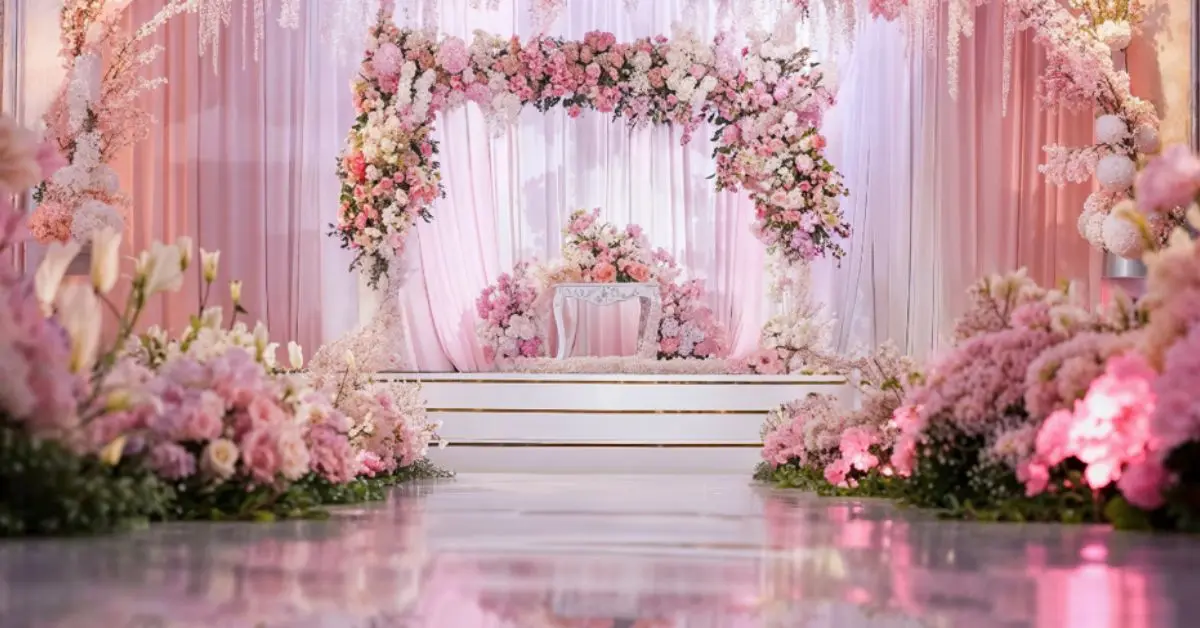
A well-made wedding setup rarely works because it is full of things. It works because someone decided what not to include. When we plan a stage for a wedding ceremony, the first real challenge is not decoration at all, it is judgment. What deserves space, what quietly supports the moment, and what only adds noise. That line is thinner than most people expect. In this blog, we will learn some tips and tricks that will help you understand how designers actually build a refined and luxurious wedding setup without making it feel crowded or overdone.
Tip 1: Get the scale right before you think about anything else
Most design issues start long before flowers or fabrics enter the picture. A stage for a wedding ceremony has to sit correctly inside the venue; everything else is just compensation work. Ceiling height, viewing distance, and the width of the room quietly decide how the stage should breathe. When those proportions are off, even good design feels slightly uncomfortable, though people usually cannot explain why. When it is right, you feel it immediately without needing to think about it.
Tip 2: Leave space where your instinct says to fill it
Negative space makes people uneasy at first because it feels like something is missing. In reality, it is doing the heavy lifting. A clean wedding ceremony stage depends on that restraint. If every surface is occupied, the eye has nowhere to rest, and the whole setup starts feeling louder than intended. The better approach is simple. Place fewer elements, but let them sit properly. The difference shows up more in photos than in words.
Tip 3: Light is not support, it is structure
Lighting gets treated like a finishing touch, but that approach rarely holds up in real venues. A stage for a wedding ceremony changes character completely depending on how it is lit. The angle matters more than the brightness. A soft backlight can give depth to something very minimal, while poor frontal lighting flattens even detailed setups. This is why experienced teams design lighting alongside structure instead of adjusting it at the end when everything else is already fixed.
Tip 4: Too many materials usually means less clarity
There is a quiet rule most designers follow without saying it out loud. The more material variety you introduce, the harder it becomes to control the final look. Fabric, florals, reflective surfaces, and structures all behave differently under light. When they are mixed without intention, the design starts to lose direction. A strong wedding ceremony stage often uses fewer materials, but each one is chosen for a reason that holds up even under scrutiny.
Tip 5: Decide what the eye should notice first and stick to it
Every stage has a hierarchy, whether it is planned or not. The problem is when it is accidental. On a stage for a wedding ceremony, the couple should never have to compete with the decor for attention. That sounds obvious, but it gets complicated quickly when design elements start getting added. Height, framing, spacing, and contrast all need to support that single focal point. If they do not, the stage becomes visually busy even if it looks expensive.
Tip 6: Repetition only works when it is controlled
Repeating elements can create rhythm, but they can also create clutter if they are done without discipline. You see this often in floral layouts where patterns continue just because there is space left. That usually weakens the design. Repetition should guide the eye, not fill gaps. Once it turns into filler, the entire stage starts to feel less intentional.
Tip 7: Assume the camera is always judging the setup
A modern stage for a wedding ceremony is not just experienced in person anymore. It is photographed from multiple distances and angles, often more than it is actually looked at directly. That changes everything. Depth matters more than decoration. Background separation matters more than surface detail. If the design collapses into a flat image, it loses half its purpose, no matter how it feels in the room.
Tip 8: Simplicity only works when it is deliberate
Simple does not mean easy. In fact, simplicity usually takes more decisions, not fewer. When unnecessary elements are removed carefully, what remains has to carry the entire visual weight. That is where restraint becomes skill. A well-designed wedding ceremony stage feels calm because nothing was done, but because everything unnecessary was taken out early enough to let the structure breathe.
At Arc Divine, this is the part we care about most, not how much we can add, but how cleanly a stage for a wedding ceremony can hold attention without trying too hard.
Conclusion
There is a point in design where adding more stops improves nothing and only starts filling space. Getting to that point takes judgment, not decoration. If you are planning a wedding and want a setup that feels composed rather than crowded, we can help you shape it with clarity and intention. Reach out to us and let’s design something that feels considered from the first idea to the final stage.
FAQs
- Indoor Stage Rentals in Palm Beach